Your credit is "checked" whenever you take out a student loan, mortgage, or car loan. It may also be checked to see if you would be a good lessee at an apartment complex. It can even be checked to see how good of a rate you may get on your cell phone bill! Your credit is important. How does one obtain great credit?
Good question. Many young people don't understand credit, but everyone should understand it. I'll give you the guidelines to understanding how your credit works. Then, I'll give you the steps to start building your credit and give it the strength that you'll need for your financial future.
Credit Guidelines
Here are some terms you should know:
- Creditor: a lender; this is either a company or an organization that is willing to lend you money or credit with an interest rate
- Credit score: Also known as your FICO score; this is your one-number evaluation of your trustworthiness to creditors; it is on a 300-850 scale, with higher being better.
- Credit report: this is the step-by-step report of all your transactions pertaining to credit, such as credit card payments or loan payments. This can also include failure to pay on utility bills and credit checks
- Hard credit pull/check: an inquiry of an organization to see your credit; this creates an item on your credit report that can be viewed as a negative factor towards your credit score
- Soft credit pull/check: the same as a hard pull, but it does not appear on your credit report; this does not affect your credit score
- Credit limit: pertaining to credit cards, this means the amount of money you are allowed to spend without paying on the balance
- Credit utilization: the amount of your credit that you spend, pertaining to credit cards; if you have a $500 limit credit card and spend $150, you have a 30% credit utilization
- Credit analyst: someone who specializes in improving other people's credit, especially those who have misused or abused his or her credit
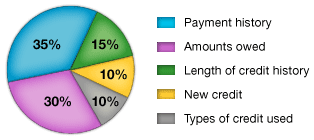
chart from www.myfico.com
- 35% Payment History
- 30% Amount Owed
- 15% Length/Time of Credit History
- 10% New Credit
- 10% Diversity of Credit
Your amount owed is simply the amount you owe on your loans and credit cards. Credit cards are simple because your "amount owed" amount is simply your credit utilization. Keep this at 30% or lower, and you're golden. If you can pay off your bill every month in full, do it. It's the best way to build credit with no negative effects. Loans are tricky because they are expected to be paid off within the time period that you signed the loan for. So, if you have a twelve month loan and pay your full bill every month, you're golden. There are a couple exceptions regarding long-term loans such as student loans, but these rules are so specific that you'll have to ask a credit analyst. If you need to speak to a credit analyst, you can speak to one for free at www.nfcc.org and call toll-free.
Your length of credit history is simply the amount of time you've had your credit cards. The longer you've had credit, the better. This means that you should never close old credit cards. Continue to use them and upgrade your credit limit on these cards.
The new credit category simply means that if you apply for multiple credit cards in a short period of time, it will reflect negatively on your credit report. Try to keep applying for credit down to once per six or twelve months.
Your credit diversity is important if you're looking to have great interest rates on loans, but that's all it's going to get you. If you don't have any need for any kind of loans such as a mortgage or car loan in your near future, don't worry about this category. If you do need to take out this expense, you should take out a "secured loan" twelve to six months before your other loan that you need. Whenever a bank agrees to give you a secured loan, you give the bank the amount of money that you will borrow. Then, you pay back that same amount plus interest. Whenever your loan is complete, you get back the amount of money that you put down as a security deposit. The reason why you want to take a secured loan is because it has a lower interest rate as compared to others. However, if you don't have the capital (money) to take out a secured loan, then you need to take out an unsecured loan. An unsecured loan is just a traditional loan; you pay back what you take out plus interest.
Establishing Credit
If your parents already had you on their credit cards as an "authorized user," then you will have a credit history. Congratulations! Apply for a credit card at your local bank. You have a great chance of being accepted off the bat due to your credit history. Go to the building credit section below once you are accepted. If you aren't accepted or if you don't have credit, then read on!
You don't have credit, but you want to get it started. The first thing you should do is check your bank. If you don't already have a bank account (or credit union account), you should skip to the next paragraph. Ask your bank or credit union about a credit card for students and tell them you have no previous credit history. Most will be more than happy to start you with a low-limit credit card.
If your bank still denied you or you don't have a bank account, you'll need to apply for a "secured card." You can apply at a local bank again or you can try cards such as Discover, Capital One, or Chase. Their secured cards force you to give the creditor a certain amount, and they'll make your limit that amount or slightly more.
Building Credit
You now have your first credit card. Follow the guidelines listed below, and you'll have a credit score within six months:
- What's your limit? Your "safe" limit is 30% of your actual limit. To find your "safe" limit, multiply your actual limit by .3. For example, the "safe" limit of a $500 credit card is $150. You are safe to spend only 30% of your actual limit at one time.
- Use your credit card at least once per month. If you go over 30% of your limit, it's OK, but you must pay it off immediately. Stay under 30% of your actual balance, and you'll be in the green.
- Earn rewards. Most credit cards offer rewards for spending money at certain stores or merchants. If you have the choice to save money by earning rewards, do it. However, if you weren't going to buy that product in the first place, don't do it.
- Never spend more money than you can afford. If you don't have enough money to cover your credit card expenses, then don't spend that money. The goal is to build credit, not risk your financial future. Credit card interest is expensive, so you never want to get hit with interest charges.
Maintaining Credit
Maintaining your credit score is easy. Continue the same steps that you applied in the "Building Credit" section, and you'll be golden. If your credit score isn't as high as you think it should be, make sure to do the steps listed in the "Credit Guidelines" section.
Thank-you for reading. Please comment with any questions you may have!


No comments:
Post a Comment