Monday, January 16, 2017

How to Start Ubering to Make Extra Cash

1. Sign up for Uber

Click here to sign up for Uber. Before you sign up, ensure that you meet the minimum requirements here. If you don't click on the link, here are the basic requirements:


  • Be 21 years old
  • Have driving experience
    • 1 year if 23+ years old
    • 3 years if 22 or younger
  • Have a U.S. driver's license
  • Have a 4-door Sedan (10 years old or newer)
  • Proof of vehicle registration
  • Proof of vehicle insurance
The Uber sign-up process is straightforward. You fill out the online forms provided, upload photos of your license, registration, and insurance, and then wait. Uber checks all your documents and performs a background check on you. In my experience, Uber finishes this process a few hours after you apply.

2. Get Prepared

Assuming you are now an Uber driver, you'll need to prepare to drive. There are several things you'll need (or at least strongly desire) to drive. This list is all you need:

  • Phone mount
  • Car phone charger
  • Uber decal
  • A "clean" car
    • No loose stuff rolling around
    • Presentable seats and floors (minimal stains, overall clean looking)
    • No strong odors
    • Door handles and passenger entry/exit areas won't leave residue on your passengers
  • Mileage journal or phone app to record mileage (for tax reporting purposes)
  • 4G-capable Smartphone with an active plan (1-2 GB per month)
Here are some optional things that may help:
  • Food/drinks for YOU; do not give passengers snacks, gum, etc. since most people don't want to eat food from a complete stranger
  • Barf bags (if you drive drunks around often)
  • Music playlist (Spotify premium or other service)
3. Start Driving

If you have met all of the requirements above and prepared yourself with at least all the needs listed above, then you're ready to drive. I recommend doing the following to have the best ratings and driving experience:


  • Whenever you get a request to pick up a passenger, call them to ensure that the pickup location is correct
  • Make sure all passengers are buckled in; safety first!
  • Play quiet background music catered to your audience
    • I live in Alabama, so I play a local country station; it's just loud enough to hear the words in the music
  • Greet passengers by asking their name; always confirm your passengers' names to avoid Ubering someone who didn't pay for you!
  • Gauge whether your passengers wants to talk or be quiet
    • Talk to the passengers that want to talk
    • Be quiet if the passenger wants to sit on his or her phone or do something else
    • If you're not sure, just be quiet and let your passenger ask you questions if he or she desires
  • Confirm the drop-off location with the passenger and let them out at a full stop

Saturday, January 10, 2015

Taxes for Students: About Tax Refunds

Tax season! If you have ever worked, you know how exciting tax season can be. Most people in high school or college will receive a refund whenever filing their taxes. Today, I will tell you why you get money from the government, and then I will tell you how to get the most money back during this tax season. I'll also tell you why a tax refund is a bad way to loan your money to the government.

HEADS UP! You can't get a refund unless you have an income. Also, it's extremely likely that you can't get one if you didn't pay taxes on your income.


Why Do I Get a Tax Refund?


You gave the government too much money. Whenever you went to work, you filled out a "W-4" form. This W-4 asks you a series of questions such as whether you're single or married, a dependent or independent, and if you have any dependents (children) of your own. For every question you answer yes to, you enter a 1 in the line next to it. Then you total up the numbers at the bottom. The total numbers represents the number of "deductions" you take off your taxes. The more deductions you have, the less tax responsibility you have. For exact amounts, go to www.irs.gov and check the current deduction amount. For example, if the deduction amount is $6,300, and you have four deductions, you will have $25,200 less taxable income. If you make $60,000, it is like you just made your income into $34,800. Get it? Good!


The less deductions you claimed, the more taxes that will be withheld from your checks. Typically, you have social security, medicare, federal taxes, and state taxes taken out. There may be even more depending on where you live. In addition to all this, your retirement savings (401k), pension, medical insurance, and other voluntary costs will also be taken out of your check. However, not all these are taxed like your normal income. Just keep all these things in mind whenever your check was supposed to be $2,000 but it actually was $800.

How to Get the Most Money Back on Your Tax Return

Claim the least amount of deductions on your W-4. This will ensure that you overpay for your taxes. You are shooting for 1 deduction claim at the maximum with this approach.

Why Should I Consider Not Getting a Tax Refund?

Investing. I recently wrote a post about investing here. Whenever you give the government your tax money, they are keeping it for up to a year. Instead of giving the government your extra money, why don't you put it to work in index funds?

If you aren't the risky kind of person, you could put your money into a high-interest savings account! You could be earning ~1% of your money back in interest. Think of it this way: Say you overpaid $3,000 on your taxes. 1% of $3,000 is $30. That leaves you with $3,030. Save again the next year. You despoit $3,000 again. You still have the $3,030 from the last year, plus 1% interest. Now you have $6,090.30 due to interest. If you keep this up, you see how it can really stack up. 

If you want to really make your money go far, invest in a retirement account such as a 401k or IRA. More on these later. I know I keep saying I'll talk about them but haven't yet. Don't worry, I will!

Thank-you for reading this article. If you have any questions, please comment them below!

Saturday, January 3, 2015

To Invest, or Not to Invest?

Should you invest? What is investing? Why should you think about investing?

Investing is simply proactive saving with a varying amount of risk. You can invest through many media, such as stocks, bonds, CDs, ETFs, mutual funds, money, cars, real estate... the list goes on and on! Your investing goals and needs will determine how you should invest.

Before you invest in anything, you should have the following:
  1. Liquid assets - a savings account with a large sum of money; this amount will be an emergency fund. If you have a car, you should have enough to replace your engine or transmission. If you have a pet, you should have enough to cover an overnight vet stay. Use this as a guide for your savings amount. If you don't have any assets/liabilities, just have $1,000+ stashed away.
  2. A checking account - you need a bank account that can easily transfer funds into or out of your investment account
  3. Income - your income should be at least 5% greater than your expenses. This makes sure that a small expense (such as an oil change or doctor visit) doesn't dip into your emergency savings account. If you don't know your income/expenses, calculate it using this link.
  4. Credit - before investing,start building credit. If you haven't already done this, click this link.
  5. Investment Account - you need an account that will allow you to invest. Try to get a low-fee account (<$10 per trade). Your fees should always be equal to or less than 2% of your principal investment. 
*WARNING* I take no responsibility for any money you may make or lose while investing. Do not invest unless you meet the criteria above AND you aren't willing to lose the money you invest. I recommend also reading in depth about investments at www.investopedia.com before making an investment choice.

At this point, you should have all five steps completed. Before we start, I want you to know that if you have less than $1,000 to invest, I would recommend to keep saving and not invest yet. You need at least $1,000 for it to be worth your time.

Quick terms:
  • Principal - the initial amount you invest
  • Asset - investment possession (ex. a stock, house, etc.)
  • APY - annual percentage yield (compounding interest rate)
  • APR - annual percentage rate (non-compounding interest rate)
  • Realized Gains - money made after selling an investment
  • Realized Losses - money lost after selling an investment
  • Unrealized Gains/Losses - change in value of investment, but it's not realized because you haven't sold your investment
  • Volatility - amount of risk of investment; usually a sign of a large change in value in a short amount of time
  • Trade - act of either buying or selling either the whole or pat of your investment
  • Liquidate - selling an asset to become money/funds
Stocks

When you buy a stock in a company, you are buying a small portion of that company. You have a claim on that company and its assets. For some stocks. you can vote on the management of the company and do other fun little things. However, most investors don't do this. You usually can't do this unless you own a significant portion of the company (we're talking hundreds of millions of dollars and more). Stock price changes every few seconds throughout the day from 8:30 a.m. to 4:30 p.m. EST, Monday through Friday (excluding federal holidays). 

Stocks are one of the most volatile (riskiest) but most rewarding methods of investing. If you buy a stock and it rises 4% that day, you've already increased your investment by 4%. If you invested $1,000, you've made $40. However, if it falls 6% the next day, your investment is only worth $977.60. 

Stocks are easily liquidated. You just sell the stock, and it's liquid money for you to use at your disposal. Easy as that. However, if no one is buying your stock at that time, then your stock will not sell. This usually won't be an issue, but know that this can happen.

Stocks are great if you know a company will excel in the near future. The only problem is that no one can ever know how well a company will do in the future. Good luck with that. 

Stocks are fun, though. You can trade them as often as you want, and they typically have somewhat low fees. However, be careful not to trade too often when you have a low principal. If your trade fee is $8.95 per trade and you have $1,000 to invest, you will eat up 2% of your principal by just buying and selling your investment. 

Stocks and ETFs are usually for those who have less than $5,000 to invest. For most college students, that means you. Every other investment is typically not open to you or not worth it in the long run. You are shooting for a 10% increase in value per year. If you can do better, good for you. If you can't, keep trying! It takes practice and a lot of research to determine what stocks to buy and when to buy them.

Bonds/CDs

A bond or CD is a loan from you to an institution. When you give the institution the money, it typically reinvests it and makes more money than you typically can. After the bond/CD term is over, the institution gives you the previously-agreed-on interest back plus interest. 

This is one of the safest kind of investments. It typically lasts from one year to ten years, with longer terms resulting in higher interest rates. Due to the low risk, you will usually yield less than 5% interest. I usually don't recommend this method to college students because it's not easy to liquidate. If you liquidate a CD or bond before your term is over, you will usually incur a fee. If you want to put away money for a long period of time (we're looking at you, retirement), then you should just invest in an IRA. More on retirement investment accounts in a later article, though. 

The only reason for you to invest in bonds or CDs is if you know you won't need the money for X amount of time, but you can't afford to lose it. Your extras that you don't put into an emergency savings account can be used for this. However, make sure that you can't get a better APY with a high-interest savings account. Again, more on bank accounts in a later article. 

Mutual Funds/ETFs

These are best investment strategies for long-term investing for non-retirement savings. A mutual fund is a collection of stocks and bonds professionally managed by some big cheese guy. An ETF is a collection of stocks. ETF stands for exchange-traded funds.

There are many types of mutual funds and ETFs. All come with varying amounts of risk. Today, we will only discuss "index" funds. An index fund tracks the stock market as a whole through the S&P 500 or other indexes. It increases in value as the stock market increases, and it decreases as the stock market decreases. INVEST IN THESE. The stock market has proven to increase every year (except during the latest recession of '08 and '09). You will make a decent amount of money if you leave your investment alone and forget about it for about thirty years or longer. You will make a lot more if you invest more money into it every year.

Get a fund with a low expense ratio. The expense ratio is the percentage that the fund owner takes out and keeps for him or herself each year. Index funds typically have extremely low expense ratios.

Mutual funds are not very easily liquidated. However, ETFs are. I recommend ETFs for general investing purposes.

Tangible Assets

This is where investing becomes really fun for some people. You can buy a Rolex for $2,000. In ten years, that same Rolex could be worth $4,000.

You can buy a used car for $5,000. You can then find someone that's willing to pay $6,000 for it and sell it to them for that much. You've made $1,000.

You can buy and sell things on eBay. Even though this may not be considered investing, you are still taking a risk and possibly turning a profit--the definition of an investment. . 


Investing is good for your wallet and your life--if you do it wisely. If you don't think you want to invest because of the risk, then don't! Just get a high-interest savings account and start saving up. If you enjoyed this post, please share it with others. If you have any other questions, please post them in the comment section below!

Tuesday, December 23, 2014

Budgeting for College: What to Expect

Whether you're going into your first, fourth, or last semester of college, you're going to need a budget. A budget helps you determine what you can afford to spend each month, and it can help make college a much more pleasurable experience--at least financially.

Pre-Budget

Before you can create a budget, you need to have a few known factors going in. First, you need to know how much money in scholarships you will receive. Here are some scholarships to consider:

  • Tuition scholarships - for those who had a great GPA and testing score before college; free tuition is affordable tuition
  • Study-specific scholarships - free money for your particular major, minor, or hobbies
  • Demographic scholarships - if you're a minority in your major, you may be eligible for a scholarship; for example, women who study engineering are usually eligible for scholarship
  • Performance-based scholarships - if you're smart and get good grades while in school, you may be eligible for these
  • External scholarships - these scholarships you have to apply for outside of your college; usually you have to write an essay and get a recommendation, but these can be very rewarding for the amount of effort required
You should also ALWAYS fill out the FAFSA. The FAFSA is the Free Application for Federal Student Aid. At the minimum, the government will offer you loans with good terms. However, you may be eligible for a pell grant. Pell grants are small amounts of money that the government will give you to pursue your first bachelor's degree. You don't have to pay them back. Think of this like a "Thank-you" from the government for collecting your future taxes.

Ask your parents if they are able to contribute to your education. Many parents have saved for their children's college expenses. If your parents offer to help, don't be too proud to accept it. This income is the difference between making and breaking it for many higher-income households. If your parents are unable to contribute, you still have plenty of options.

Budgeting

I recommend doing this AFTER you get results from your FAFSA. If no deadlines will pass, it would be wise to wait to make your budget until you know the results on all your scholarships.

This is the time to clear your head, remove any dreams you may have, and be realistic. You probably will need your help estimating all your costs. A great tool to use is the Wells Fargo College Budget. It has all categories that you need to worry about taken care of. Whatever costs you anticipate, always assume you will spend a few dollars more per month. That way, if you ever do spend what you anticipate, you'll still be under budget.
*NOTE* If you don't know what your college expenses may be, your college should have it advertised under their financial aid section. Make sure to find a "price calculator" and use these numbers. They tend to be somewhat accurate.

Calculate your total expenses on the worksheet. Then, calculate your total GUARANTEED income. If you're not sure that you'll receive a scholarship or grant, don't use it as your income.

Subtract your guaranteed income by your expenses. If that number is negative, you will need to take out loans for that amount or get a job to cover that expense. If you have never been to college, I recommend taking out the loan and trying out the job to see if a job is right for you. Some people can balance a job with college, whereas others can't. Never take on something that you can't handle! However, if the result of your previous calculation was positive, then there is a good chance that your budget is healthy.


Good luck budgeting for school. If you have any more questions, please comment with them below!

Monday, December 22, 2014

More Advanced Credit Management: Credit Cards and Loans

This post is for those who have had an active credit history for at least six months. If you don't have any credit history yet--or any that you know of--then click here to explore the world of credit at a beginner's level.

Why does credit matter? Your credit is important because it can save you thousands of dollars every year. Everything that you must borrow will be cheaper if you have great credit. 

Everyone wants the highest credit score possible. How can someone achieve an 800+ credit rating? Great credit management. How does one manage his or her credit effectively?

There are two great ways to manage your credit--credit cards and loans. Credit cards are convenient, easy, and have many perks to go along with them. Loans, on the other hand, are fixed amounts of money owed to an institution that diminish your net worth. Keep reading to see how to utilize these two forms of credit to benefit your credit worthiness.

*Note* You must have some form of credit for any of the information below to apply.

Credit Cards

Most people already have at least one credit card. Credit cards are known as "revolving credit." This credit is extended to you each month. In return, your creditor is hoping that you borrow too much at one time so that you pay huge amounts of interest. However, at The College Finances, we are smarter than that. Here are the DOs and DON'Ts of credit cards.
DO
  • Pay your bill in full every single month, without fail
  • Utilize cash rewards
  • Use your card at least once per month
  • Ask for limit increases whenever your income increases or once per year
DON'T
  • Spend more than 30% of your limit at one time
  • Lend your credit card to others
  • Pay only the minimum payment on your bill
  • Carry a balance over month-to-month
  • Close your credit card (ever!)
If you follow those simple rules above, you credit will improve over time.

It's also wise to have at least two credit cards. Try to upgrade your current credit card as your credit improves. If you do this, not only will your credit limit increase, but your line of credit will continue to age (good), and you could get better rewards from your credit card. Take full advantage of any offers/rewards offered by your card--why not, right? It's free money just because you manage your credit wisely.

I recommend having a credit card that offers the greatest cash back for every kind of purchase you make. For example, you should purchase gas on a credit card that offers 5% cash back on transportation expenses. You should have another credit card that offers 5% cash back on dining expenses. 
*WARNING* I am not endorsing "store" credit cards. Their perks are not very good, and some store cards don't even report your activity to the major credit bureaus. Avoid store cards and stick with major financial institutions.

I also recommend checking out www.creditkarma.com for actively managing your credit. They provide you with a TransUnion score and show you where you can improve your credit score. The number they provide you isn't your FICO score, but it's good enough to interpret where you're at and where you want to be. Best of all, as of 12/21/2014, it's free.

Loans

There are several types of loans--car loans, mortgages, personal loans, and student loans. All are very similar in how they affect your credit. Loans are considered "installment credit." This credit is loaned to you at one instance, and you are expected to pay it off on a predetermined schedule. I recommend you have an active loan at all times in order to diversify your credit report and show that you are a responsible borrower. 

Student Loans
These loans are the most preferable to have active. You can have them deferred while you are attending school--which does not affect your credit--and pay on them after you graduate college. The federal government offers two kinds of student loans--subsidized and unsubsidized. Depending on your family's income, you will be offered either both loans or just unsubsidized loans. Unsubsidized loans collect interest while you attend college, whereas subsidized loans don't collect interest while you attend college. Also, subsidized loans have a slightly lower interest rate. The loans that are wonderful for your credit are Federal Perkins student loans. They report as being paid each month while you're attending college. These loans are only available for low-income students who qualify for subsidized federal loans, and they're not offered by all universities. Make sure to establish a repayment plan with your student loan provider that has no more than a five-year term. Otherwise, it could negatively affect your credit due to the "payback" time period.

Personal Loans
Personal loans are loans you take out with a financial institution in order to cover an unexpected expense. The unexpected expense can range from a broken transmission to paying for higher-interest debt. Never pay for an unexpected expense with a credit card unless you can pay it off within that billing period. These loans offer an opportunity to also build up your credit by creating an installment loan on your credit report. As long as you pay these on time every month, they will be an asset to your credit. You can also use these loans to pay off high-interest debt that you have neglected to pay off--just make sure the interest rate on the new loan is lower than your old debt. Ideally, however, you should have a rainy day fund saved up so that you don't have to take on this loan.

Auto Loans
This should be the first voluntary loan that you take out. Car loans are the baby version of a mortgage--they are less expensive and typically are the first step after college. It's a good idea to take out an auto loan after your credit rating reaches 720+ for a great interest rate. If your rating is not there yet, continue paying on student loans and your credit cards. However, if you don't have student loans, it may be wise to take out a $1,000 secured loan with a short term in order to build your credit up to your desired level. The interest rate on these loans (as of 12/21/2014) can be as low as 5%. 5% of $1,000 is much less than the difference between having a 10% interest auto loan or a 2% interest auto loan. Even better, some auto companies offer 0% interest to those who have excellent credit during certain seasons. Make sure to be on the lookout for these whenever you're trying to finance a car.

Mortgages
Ah, yes. The big daddy of all loans. This loan can range from as low as $50,000 all the way up to $1,000,000+. This loan should be the last one on your list since you want a very low interest rate. A huge loan like this can cost you thousands more per year if you take on this one first. You want to have a great history with student loans, credit cards, and an auto loan before you take on a mortgage. I recommend having a credit rating of at least 780 before signing for a loan. You will receive some of the best rates available. I also recommend signing a mortgage for no longer than 15 years so that you can either upgrade your house in the somewhat-near future, or you can live mortgage free for many years to come.

If you follow the steps listed above, your credit rating will be strong and propel you through your financial future. If you still have any more questions, please feel free to comment with them below. Thank-you for reading!

Saturday, December 20, 2014

How to Establish and Build Credit

Credit is an amazing tool to financial success. It has the ability to give you interest-free loans and the most luxurious credit cards. In the long run, your credit can save you thousands of dollars every year. However, if you misuse and abuse your credit, you can cost yourself those same thousands plus even more.

Your credit is "checked" whenever you take out a student loan, mortgage, or car loan. It may also be checked to see if you would be a good lessee at an apartment complex. It can even be checked to see how good of a rate you may get on your cell phone bill! Your credit is important. How does one obtain great credit?

Good question. Many young people don't understand credit, but everyone should understand it. I'll give you the guidelines to understanding how your credit works. Then, I'll give you the steps to start building your credit and give it the strength that you'll need for your financial future.

Credit Guidelines

Here are some terms you should know:

  • Creditor: a lender; this is either a company or an organization that is willing to lend you money or credit with an interest rate
  • Credit score: Also known as your FICO score; this is your one-number evaluation of your trustworthiness to creditors; it is on a 300-850 scale, with higher being better.
  • Credit report: this is the step-by-step report of all your transactions pertaining to credit, such as credit card payments or loan payments. This can also include failure to pay on utility bills and credit checks
  • Hard credit pull/check: an inquiry of an organization to see your credit; this creates an item on your credit report that can be viewed as a negative factor towards your credit score
  • Soft credit pull/check: the same as a hard pull, but it does not appear on your credit report; this does not affect your credit score
  • Credit limit: pertaining to credit cards, this means the amount of money you are allowed to spend without paying on the balance
  • Credit utilization: the amount of your credit that you spend, pertaining to credit cards; if you have a $500 limit credit card and spend $150, you have a 30% credit utilization
  • Credit analyst: someone who specializes in improving other people's credit, especially those who have misused or abused his or her credit
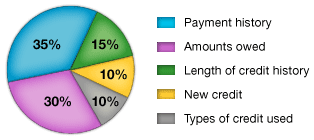
Your credit score is determined by the following factors on your credit report:
FICO Scores chart
chart from www.myfico.com
  • 35% Payment History
  • 30% Amount Owed
  • 15% Length/Time of Credit History
  • 10% New Credit
  • 10% Diversity of Credit
Your payment history is determined by your reliability of paying on time every month. If you pay your credit card(s) and loan(s) on time every month, you get full marks for this category.

Your amount owed is simply the amount you owe on your loans and credit cards. Credit cards are simple because your "amount owed" amount is simply your credit utilization. Keep this at 30% or lower, and you're golden. If you can pay off your bill every month in full, do it. It's the best way to build credit with no negative effects. Loans are tricky because they are expected to be paid off within the time period that you signed the loan for. So, if you have a twelve month loan and pay your full bill every month, you're golden. There are a couple exceptions regarding long-term loans such as student loans, but these rules are so specific that you'll have to ask a credit analyst. If you need to speak to a credit analyst, you can speak to one for free at www.nfcc.org and call toll-free.

Your length of credit history is simply the amount of time you've had your credit cards. The longer you've had credit, the better. This means that you should never close old credit cards. Continue to use them and upgrade your credit limit on these cards.

The new credit category simply means that if you apply for multiple credit cards in a short period of time, it will reflect negatively on your credit report. Try to keep applying for credit down to once per six or twelve months. 

Your credit diversity is important if you're looking to have great interest rates on loans, but that's all it's going to get you. If you don't have any need for any kind of loans such as a mortgage or car loan in your near future, don't worry about this category. If you do need to take out this expense, you should take out a "secured loan" twelve to six months before your other loan that you need. Whenever a bank agrees to give you a secured loan, you give the bank the amount of money that you will borrow. Then, you pay back that same amount plus interest. Whenever your loan is complete, you get back the amount of money that you put down as a security deposit. The reason why you want to take a secured loan is because it has a lower interest rate as compared to others. However, if you don't have the capital (money) to take out a secured loan, then you need to take out an unsecured loan. An unsecured loan is just a traditional loan; you pay back what you take out plus interest.

Establishing Credit

If your parents already had you on their credit cards as an "authorized user," then you will have a credit history. Congratulations! Apply for a credit card at your local bank. You have a great chance of being accepted off the bat due to your credit history. Go to the building credit section below once you are accepted. If you aren't accepted or if you don't have credit, then read on!

You don't have credit, but you want to get it started. The first thing you should do is check your bank. If you don't already have a bank account (or credit union account), you should skip to the next paragraph. Ask your bank or credit union about a credit card for students and tell them you have no previous credit history. Most will be more than happy to start you with a low-limit credit card.

If your bank still denied you or you don't have a bank account, you'll need to apply for a "secured card." You can apply at a local bank again or you can try cards such as Discover, Capital One, or Chase. Their secured cards force you to give the creditor a certain amount, and they'll make your limit that amount or slightly more.

Building Credit

You now have your first credit card. Follow the guidelines listed below, and you'll have a credit score within six months:


  1. What's your limit? Your "safe" limit is 30% of your actual limit. To find your "safe" limit, multiply your actual limit by .3. For example, the "safe" limit of a $500 credit card is $150. You are safe to spend only 30% of your actual limit at one time. 
  2. Use your credit card at least once per month. If you go over 30% of your limit, it's OK, but you must pay it off immediately. Stay under 30% of your actual balance, and you'll be in the green.
  3. Earn rewards. Most credit cards offer rewards for spending money at certain stores or merchants. If you have the choice to save money by earning rewards, do it. However, if you weren't going to buy that product in the first place, don't do it.
  4. Never spend more money than you can afford. If you don't have enough money to cover your credit card expenses, then don't spend that money. The goal is to build credit, not risk your financial future. Credit card interest is expensive, so you never want to get hit with interest charges.
Maintaining Credit

Maintaining your credit score is easy. Continue the same steps that you applied in the "Building Credit" section, and you'll be golden. If your credit score isn't as high as you think it should be, make sure to do the steps listed in the "Credit Guidelines" section.

Thank-you for reading. Please comment with any questions you may have!